
How to Measure for Curtains: The Complete Step-by-Step Expert Guide
Getting curtain measurements wrong is one of the most common — and most costly — mistakes in home decorating. This complete guide walks you through every measurement you need, the formulas professionals use, and the mistakes to avoid before you order a single panel.
What You Need Before You Start
Accurate curtain measurements begin with the right tools and a clear understanding of what you’re measuring. Guessing or using a fabric tape will introduce errors that make curtains look unprofessional and feel wrong in the room.
Tools You Need
- Steel retractable tape measure — fabric tapes stretch; always use metal
- Pencil and notepad — write every number down immediately
- Step ladder — for reaching the rod or top of the window frame
- Your curtain rod or track — ideally already installed, or at minimum marked on the wall
💡
Pro Tip
Always install or firmly mark the position of your curtain rod before measuring. The rod position determines both the width and the drop. Measuring from the window frame and adjusting later leads to errors.
Two Numbers You’ll Always Need
No matter the window style or curtain type, every measurement comes down to two critical numbers:
- Finished Width — how wide your curtains will be when hung and opened
- Finished Drop (Length) — how long your curtains will hang from rod to hem
Everything else — fabric quantity, panel count, heading type — flows from these two figures.
Step 1 — Install or Mark Your Curtain Rod Position
1
Position the Rod Above the Window
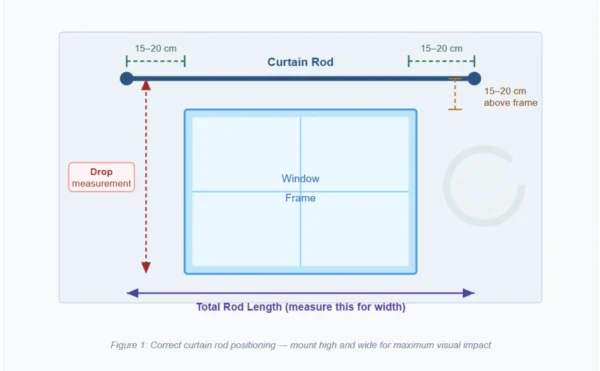
Mount the rod 15–20 cm (6–8 inches) above the window frame. For low ceilings, you can go higher — right up to the ceiling — to create the illusion of height.
2
Extend the Rod Beyond the Frame
The rod should extend 15–20 cm (6–8 inches) beyond the window frame on each side. This allows the curtains to stack back off the glass when open, maximising natural light and making the window appear wider.
✅
Designer Trick
Hanging curtains high and wide is the single most impactful decorating trick. It makes a standard 90 × 120 cm window feel like a feature floor-to-ceiling window with minimal effort.
Window
Frame
Curtain Rod
15–20 cm
above frame
15–20 cm
15–20 cm
Drop
measurement
Total Rod Length (measure this for width)
Figure 1: Correct curtain rod positioning — mount high and wide for maximum visual impact
Step 2 — Measure the Curtain Width
The width of your curtains is not the width of your window. It’s the length of your curtain rod or track, multiplied by a fullness factor.
2a
Measure the Full Rod or Track Length
Measure from end to end of your rod or track — not bracket to bracket. This is your Track/Rod Width.
2b
Apply the Fullness Multiplier
Multiply the rod width by a fullness factor to get the total fabric width needed across all panels combined.
Width Formula
Total Curtain Width = Rod Length × Fullness Factor
Example: 150 cm rod × 2.0 fullness = 300 cm total curtain width
(Split across 2 panels = 150 cm per panel)
⚠️
Common Mistake
Do not measure just the window glass or the window frame for your curtain width. Always measure the rod or track — which should already extend beyond the frame — to get the correct base measurement.
Step 3 — Measure the Drop (Length)
The drop is the finished length of your curtain — from the hanging point down to where the hem should sit. There are four standard drop positions.
3a
Identify Your Hanging Point
- Rod with rings: Measure from the bottom of the ring
- Eyelet curtains: Measure from the top of the pole
- Track/rail: Measure from the bottom of the track
- Tab tops: Measure from the top of the pole
The Four Standard Drop Lengths
Drop Formula (Floor Length Example)
Finished Drop = Distance from ring/track bottom to floor − 1.5 cm
Example: Hanging point to floor = 240 cm → Finished drop = 238.5 cm
✅
Measure in Three Places
Floors are rarely perfectly level. Measure the drop at three points — left, centre, and right — and use the smallest measurement so no panel drags on the floor.
Step 4 — Add Hem and Heading Allowances
Your finished measurements need allowances added for the fabric that gets folded into hems and headings. This turns your finished size into your fabric cutting size.
Final Fabric Cutting Length
Cutting Length = Finished Drop + Bottom Hem (15–20 cm) + Heading Allowance (5–8 cm)
Example: 240 cm drop + 20 cm hem + 8 cm heading = 268 cm cutting length
Measurements by Curtain Type
Different heading and hanging styles require slightly different measurement approaches.
Eyelet Curtains
- Width: Rod length × 2.0 to 2.5 fullness
- Drop: Measure from the top of the pole, then subtract 3–4 cm
- Important: The top heading folds back by 3–4 cm; add this to your cutting length
Pencil Pleat Curtains
- Width: Rod/track length × 2.0 to 2.5 fullness
- Drop: Measure from the bottom of the ring or hook
- Heading allowance: 8–12 cm for the pleat tape turnover
Pinch Pleat Curtains
- Width: Rod/track length × 2.0 to 2.5 fullness
- Drop: Measure from the bottom of the hook or ring
- Heading allowance: 10–15 cm for the deep heading
Tab Top Curtains
- Width: Rod length × 1.5 to 2.0 fullness
- Drop: Measure from the top of the pole, then add 5–8 cm for the tab length
Sheer / Voile Curtains
- Width: Rod length × 2.5 to 3.0 fullness minimum
- Drop: Standard measurement — floor length sheers look best
- Tip: Layer sheers behind heavier drapes on a double rod or track
Understanding Curtain Fullness
Fullness is the ratio of total curtain fabric width to the rod width it covers. It is the single most important factor in determining whether curtains look opulent or sparse.
The key rule: when in doubt, go fuller. Curtains that are too flat look cheap regardless of fabric quality. Too much fullness reads as luxury.
📐
The “Two Widths Per Panel” Rule
A standard Dubai curtain “width” is typically 137 cm of fabric. For a 150 cm rod at 2× fullness, you need 300 cm total — meaning you’d order 3 standard widths (3 × 137 = 411 cm) split across 2 hanging panels. Always round up, never down.
7 Common Curtain Measuring Mistakes to Avoid
- Measuring the window glass instead of the rod. The rod extends well beyond the frame. Always measure the rod, not the glass or frame opening.
- Forgetting the fullness multiplier. Ordering curtains at the same width as the rod creates flat, undraped panels that look institutional, not designed.
- Not accounting for the hanging method in the drop. An eyelet drops 3 cm lower than a hook or ring at the same point. Heading style changes where measurement starts.
- Only measuring once. Measure width at the top, middle, and bottom. Measure drop at left, centre, and right. Use the smallest figure.
- Ignoring pattern repeats. A large pattern repeat can require 30–50% more fabric. Calculate extra fabric per repeat per cutting width.
- Hanging the rod too low. A rod at window frame level confines the curtain. Hung 15–20 cm higher, the same curtain adds significant architectural height.
- Measuring for lining separately. Lining is cut to the same finished measurements (minus the top heading allowance). Do not add extra width to the lining.
Quick-Reference Measurement Cheat Sheet
📐 Curtain Measurement at a Glance
Rod position
15–20 cm above frame
Rod extends beyond frame
15–20 cm each side
Width fullness (standard)
2× rod length
Floor length clearance
1–2 cm above floor
Bottom hem allowance
15–20 cm
Heading allowance
5–15 cm (by type)
Measurement Checklist Before You Order
- ✓Rod/track is installed (or firmly marked) before measuring
- ✓Rod is 15–20 cm above the window frame
- ✓Rod extends 15–20 cm beyond the frame on each side
- ✓Full rod length measured (not just the window glass)
- ✓Fullness factor chosen and applied to rod width
- ✓Drop measured from the correct hanging point (ring/eyelet/track)
- ✓Drop measured in three positions — using the smallest figure
- ✓Hem and heading allowances added to the cutting length
- ✓Pattern repeat accounted for (if applicable)
- ✓All numbers written down and double-checked
Frequently Asked Questions
The Bottom Line
Getting curtain measurements right is less about having a design eye and more about following a reliable process — in order. Install your rod first. Measure the rod, not the window. Apply a fullness multiplier. Measure the drop from the correct hanging point. Add your hem and heading allowances. Check every number twice.
Follow these steps and your curtains will hang beautifully, frame the window exactly as intended, and look like they were specified by a professional — because now, they were.
📌
Save This Guide
Bookmark this page and return to it every time you measure a new room. The formulas don’t change — only the numbers do. if you still have any question just ask emiratescurtains.ae expert or direct call on +971 55 472 2980